The Missing Public-Policy Ecosystem Behind Expensive AI Tokens
Why the biggest institutional problem is not compute cost alone, but the missing mechanism that passes technological gains on to users.

The Missing Public-Policy Ecosystem Behind Expensive AI Tokens
Why the biggest institutional problem is not compute cost alone, but the missing mechanism that passes technological gains on to users.
A note to readers: I am a native Chinese speaker, and this is my first time posting to this community. This essay was originally written in Chinese and then translated and adapted for English readers. I welcome corrections, especially where a Chinese institutional term has no exact English equivalent.
Terminology note: I use “token,” “token price,” and “AI pricing” somewhat loosely when the argument does not depend on the distinction.

A few days ago, I read Orange AI’s essay, AI Is Really Too Expensive. Its complaint about model prices—and about those prices squeezing the room available for applications—quickly resonated with a great many people.
That is, quite obviously, a good thing. Since the recent OpenClaw “lobster” craze, more and more people have stopped being satisfied with asking a model a few questions. Programmers want it to build an entire project. Researchers want it to help them publish a few more papers. Office workers want it to get them home earlier. Companies want agents inside customer service, marketing, R&D, and internal operations. Even former multi-level-marketing hustlers and degree-mill elites have formed a sacred alliance, covering themselves in hackathon badges and “child prodigy” titles in preparation for getting rich.
The more useful the model becomes, the more steps people want it to take. Every extra step shows up, with admirable clarity, on the token bill.

No one seriously denies that AI is already useful. Nearly everyone agrees that the price is absurdly high.
Hidden inside that complaint is a consensus: we expect AI to become a necessity of future life, something closer to water, electricity, and gas than to an optional piece of software.
And that expectation is not unreasonable. China has been unusually explicit in recognizing data as a factor of production. Tokens—the metered output of AI systems driven by compute and trained on data—inherit some of the economic importance of those underlying inputs.
Only four years have passed since 2022, yet AI has already entered ordinary homes and workplaces. Its role will only deepen. The rest of us office drones already bring AI to work; before long, working without it may feel nearly impossible.
The parallel with the great global internet expansion is hard to miss, and AI may ultimately reach even further. Once “Internet Plus” became a national slogan, platforms sprang up everywhere, and the world acquired the excellent habit of panicking whenever a phone lost Wi-Fi.
That suggests a kind of historical inertia. In the previous generation of general-purpose technology, the Chinese state learned how to organize infrastructure investment, constrain bottleneck operators, restructure tariffs, compensate universal service, and transmit technological cost reductions through the market—helping create a much larger and more dynamic economy.
Generative AI is now displaying the classic features of a general-purpose technology. It improves continuously, enters a wide range of industries and production processes, and becomes a common input into research, writing, design, customer service, decision-making, and automation.1
Governments could do something similar again. So far, they have not. That is the biggest institutional reason AI tokens remain expensive.
Beyond the Reach of Private Business
When should the price of a product become a public question? The answer cannot simply be “when it is expensive.” Luxury goods may be expensive. Frontier products may be expensive. What calls for special institutional treatment is an input that enters nearly every industry, so that its price propagates along entire supply chains.
That is why water, electricity, communications, and energy cannot be treated exactly like ordinary consumer goods. A small reduction in their unit cost does not merely sell more of one product. It increases society’s ability to reorganize production, exchange information, and create things that did not exist before. Across different countries, such inputs are therefore often supplied directly by the state or local public enterprises, or by private firms operating under strict franchises, price regulation, and universal-service obligations.
Not every part of water, electricity, or gas supply is a natural monopoly. The clearest natural-monopoly characteristics usually lie in the network itself: transmission grids, distribution grids, water mains, and gas pipelines. These require immense upfront investment; duplicating them is expensive; and a single operator may be more efficient. Yet the same conditions leave users with few alternatives, making it easy for an operator to convert economies of scale into monopoly rent. Whether publicly or privately owned, these bottleneck layers are therefore rarely allowed to price themselves like ordinary goods. They face cost review, price caps, fair-access rules, continuity requirements, and universal-supply obligations.
The point of state intervention is not merely to make one commodity a little cheaper. It is to stop the controller of a foundational network from capturing all the gains from technological progress, and to keep lower infrastructure costs flowing onward to factories, shops, households, and industries that have not yet been invented.2
This does not mean that the entire AI industry is a natural monopoly, or that every model should be government-priced. The question is narrower: are compute, foundation models, and data developing bottleneck characteristics of the same kind—and why has the state not yet built an equivalent mechanism for passing cost reductions through them?
Once we separate the three central inputs, the answer becomes clearer.
Compute is machine time that genuinely consumes electricity and scarce chips. A foundation model absorbs very large fixed costs in training, research, and deployment; later calls still consume inference resources, but the model does not have to be retrained for every new user. Data is stranger still: one party’s use generally does not prevent another party from using it. A token is the receipt issued to the user after these three inputs have been organized into a service.
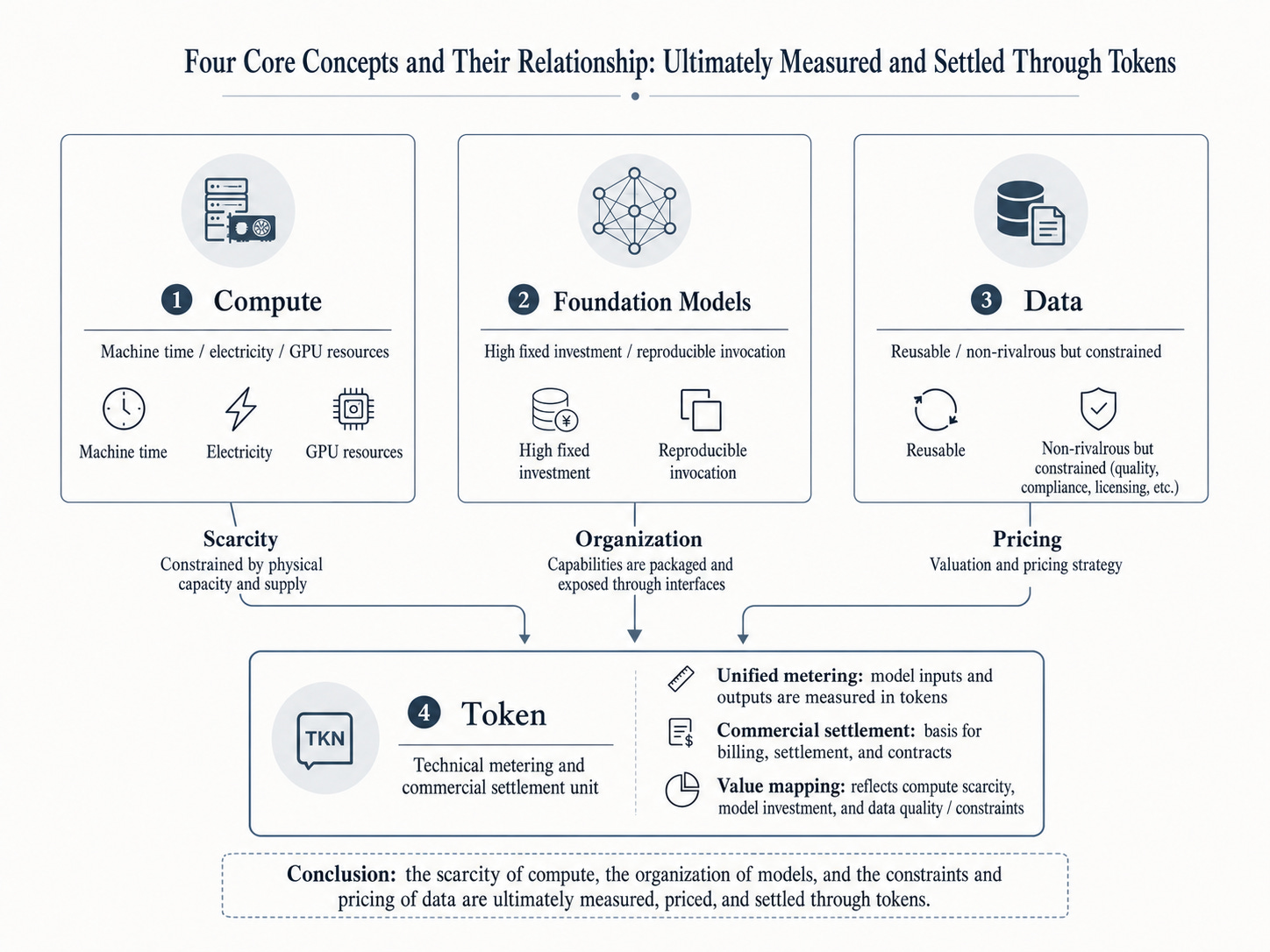
The production-input character of tokens does not arise magically from the word token. It comes from the scarcity, organization, and distribution of compute, models, and data, all of which are ultimately expressed through token-based metering and settlement. A shortage of chips, a contractual lock-in, another margin, or a monopoly at any upstream layer eventually becomes another line on a developer’s bill.
AI is not yet like municipal water, with one pipe that the whole industry cannot avoid. But it has already grown sluice gates at several critical points. Advanced chips are concentrated among very few suppliers. Hyperscale clouds command enormous amounts of compute and enterprise demand. Leading model companies must continually purchase cloud capacity. Important datasets may be difficult or impossible to substitute. These layers can exhibit high fixed costs, economies of scale, switching costs, and vertical integration.
The U.S. Federal Trade Commission’s study of major cloud providers and foundation-model companies found that their partnerships may affect other firms’ access to key inputs such as compute, while technical constraints, long-term cloud-spending commitments, and contractual arrangements can raise the cost of switching cloud providers or using multiple clouds.3
China’s recently issued antitrust guidelines for public utilities offer a useful way to think about the problem. They distinguish natural-monopoly layers from competitive layers and seek to prevent operators from extending control over a physical network or essential facility into adjacent markets through refusal to deal, exclusive dealing, tying, or discriminatory treatment. The guidelines cover water, electricity, gas, heat, and public transport—not AI. But the structural principle travels well: control the bottleneck, open access, preserve competition. Applied to AI, a company should not be allowed to control cloud capacity, chips, or a key model gateway and thereby decide who gets to survive downstream and who must buy at a prohibitive price.4
This is a problem socialist market economies have faced for a long time: infrastructure may be commercially operated, and competitive products may be market-priced, but bottlenecks that determine the productive capacity of society cannot be allocated solely according to the private profit-maximization of whoever happens to control them.
And state intervention can, in fact, reduce the price of foundational services. That is not a political wish. History has demonstrated it repeatedly.
From Installation Fees to “Faster Speeds, Lower Fees”
The history of Chinese telecommunications pricing is an unusually good case of state intervention.
The first thing it teaches, however, is that government does not naturally mean low prices.
Older Chinese readers will remember the telephone installation fee and the mobile access fee. These were government funds established to overcome inadequate communications infrastructure and a shortage of construction capital. An OECD review found that installation-fee revenue equaled 35.7 percent of total industry investment during the Sixth Five-Year Plan, 30.3 percent during the Seventh, and 39.4 percent during the Eighth; it still accounted for roughly 30 percent during the Ninth. At a time when public finance and corporate financing were limited and telephone lines were acutely scarce, making new users prepay part of network construction genuinely helped form the capital base of China’s telecommunications industry.5
The historical role of that charge resembles the early stage of today’s AI industry. It stood like a high dam: expensive, exclusionary, but also supporting the initial accumulation of infrastructure.
Fortunately, the construction-era charge was not allowed to live forever.
As the network expanded, users multiplied, and equipment costs declined, the installation fee changed from a construction instrument into an entry barrier. In 2001, the Ministry of Finance and the former Ministry of Information Industry abolished local-telephone installation fees, mobile-network access fees, and related government levies attached to basic telecommunications charges. The official account was explicit: those fees had once promoted communications construction, but once capacity broadly met social demand, abolition was needed to reduce the burden on society and normalize the distribution of government revenue.6
The rise and fall of the installation fee establish an important principle: high prices may be justified during an early period of technical scarcity, but when that scarcity recedes, public intervention can and should bring prices down.
A tollbooth erected to finance a road must eventually be removed after the road has been built. Otherwise, a mechanism of capital formation mutates into a mechanism of permanent rent extraction.
The reform around 2001 was not a uniform percentage cut across every telecommunications charge. It was a tariff rebalancing. Some local fixed-line charges increased; long-distance calls, international calls, leased lines, and internet access fell sharply. Some international, leased-line, and internet-access prices declined by roughly half. Policy deliberately lowered the costs most likely to obstruct information flows, business connectivity, and the entry of new operators.5
The OECD’s judgment was direct. Because the government still intervened in the pricing of almost all basic telecommunications services, the price reductions following the abolition of installation and access fees came primarily from government decisions rather than free competition between firms; the report expected government action to drive further reductions in the years ahead.5
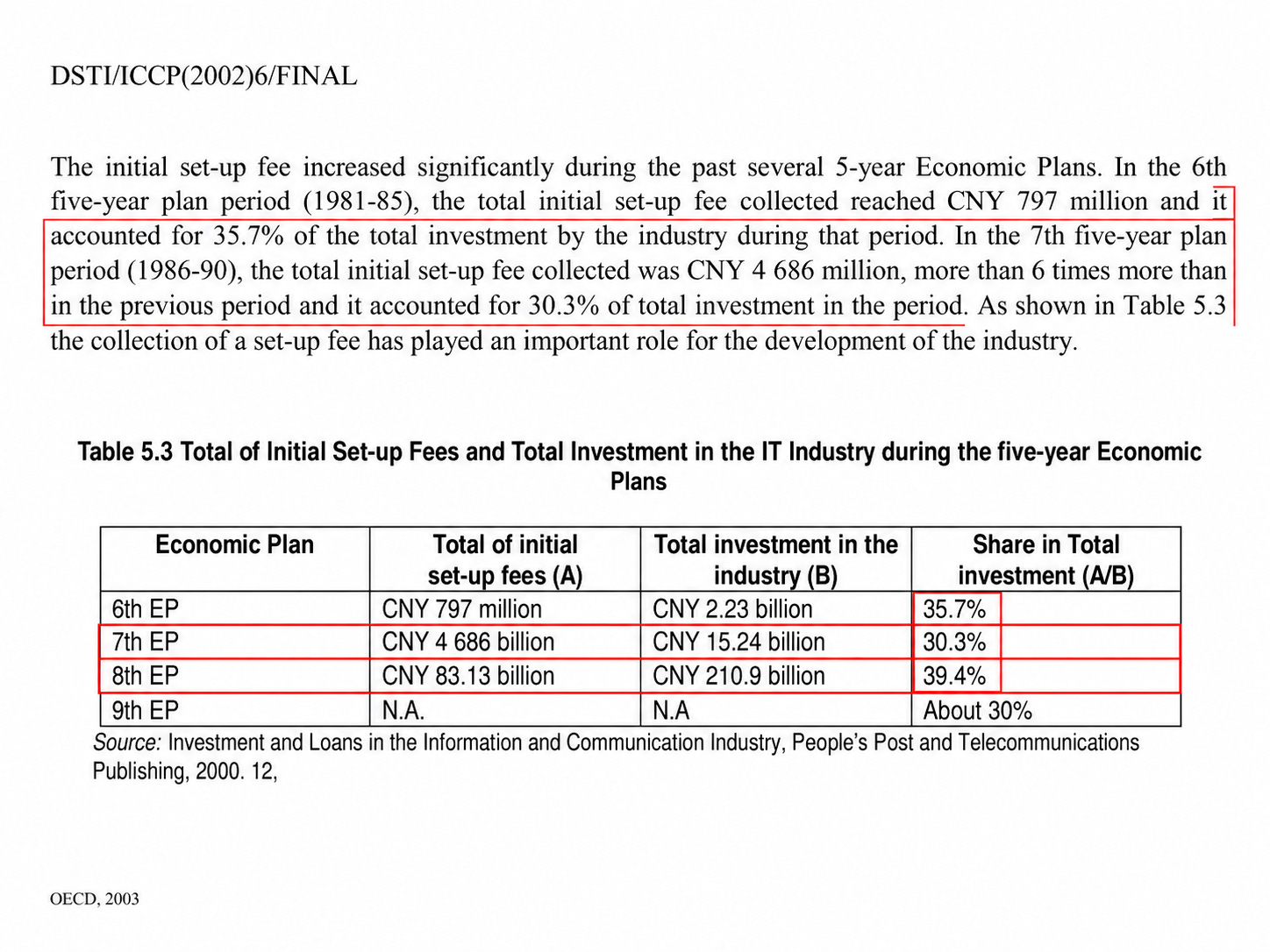
That is enough to establish that state intervention can directly reduce the price of foundational services.
But a faithful account of the history must include the other half.
Administrative repricing can reduce prices quickly, but cannot by itself create a healthy market over the long term. The same OECD report criticized excessively absolute administrative decisions, weak regulatory transparency, entry restrictions, and interconnection charges without a sound cost basis. If a ministry simply determines every price, tariff changes can become entangled with political and departmental interests and still fail to produce sustainable competition. The report therefore called for interconnection, unbundled access, improved tariff rules, universal service, number portability, more independent and transparent regulation, and fair, nondiscriminatory, cost-oriented access to the networks of dominant operators.5
The OECD’s friendly warning about administrative price cuts is especially useful today, because it explains how a one-off intervention becomes a durable system.
Telecommunications had already exposed a problem that feels familiar in AI. The owner of a foundational network also competed in downstream services. It sold wholesale capacity to rivals while competing against them at retail. If interconnection was overpriced, access quality was poor, or service could be withdrawn unpredictably, formally opening the market would not create real competition. Wholesale terms determined whether downstream firms could live.
Competition, therefore, was not something that grew naturally after government withdrew. It had to be constructed through interconnection rules, cost accounting, market access, nondiscrimination, and user mobility.
Universal service posed the same problem. Under monopoly operation, an operator could use profitable urban and long-distance services to subsidize rural and remote users. Once competition intensified, companies naturally chased the most profitable customers, and the old implicit cross-subsidy became unstable.
The OECD warned that forcing China Telecom to shoulder universal service without compensation would weaken its finances and could delay network construction in western regions. Social objectives needed explicit responsibilities, funding, and compensation—not a command to keep losing money indefinitely.5
The 2015 national campaign for “faster speeds and lower fees” eventually assembled these lessons into a more complete pricing system.
The State Council did not merely tell the three major carriers to change their plans. It simultaneously promoted all-fiber and 4G investment, expanded backbone interconnection, encouraged infrastructure sharing, opened broadband access and mobile resale markets, addressed obstacles to base-station and residential-estate access, and strengthened billing notices and consumer protection. Broadband was formally described as strategic national public infrastructure. The policy also called for changes to the performance evaluation of state-owned carriers and created a universal-service compensation mechanism—guided by the central government, coordinated locally, and implemented by enterprises—for rural and remote areas that could not be covered by commercial returns alone.7
This was unquestionably administrative intervention. But it was not a leader slamming the table and ordering three companies to perform charity for several years. The visible hand of the state helped extend the market’s capillaries into the daily life of 1.4 billion people. In doing so, it cleared obstacles that commercial firms could not—or would not—clear on their own.
Later universal-service pilots used competitive tendering, government procurement contracts, fiscal subsidies, performance acceptance, and public disclosure. Enterprises built and operated networks, while the costs created by public objectives were compensated explicitly.8
A complete pricing system had taken shape. The state demanded lower prices while reducing the institutional cost of network construction, interconnection, financing, siting, and universal service. It asked state-owned firms to yield margin while changing the way those firms were evaluated. It introduced competition while building the wholesale and interconnection conditions that made competition real.
The results were visible. According to the Ministry of Industry and Information Technology, after three years of the campaign, the unit price of fixed broadband had fallen by roughly 90 percent and the average unit tariff paid by mobile users by about 83.5 percent. By 2021, State Council Information Office figures put the decline in average fixed-broadband price per unit of bandwidth and mobile-data price per unit of traffic at more than 95 percent relative to 2015. These measures do not capture every household’s actual bill, but they clearly show that administrative action, infrastructure expansion, and market reform jointly changed the cost curve of communications.9
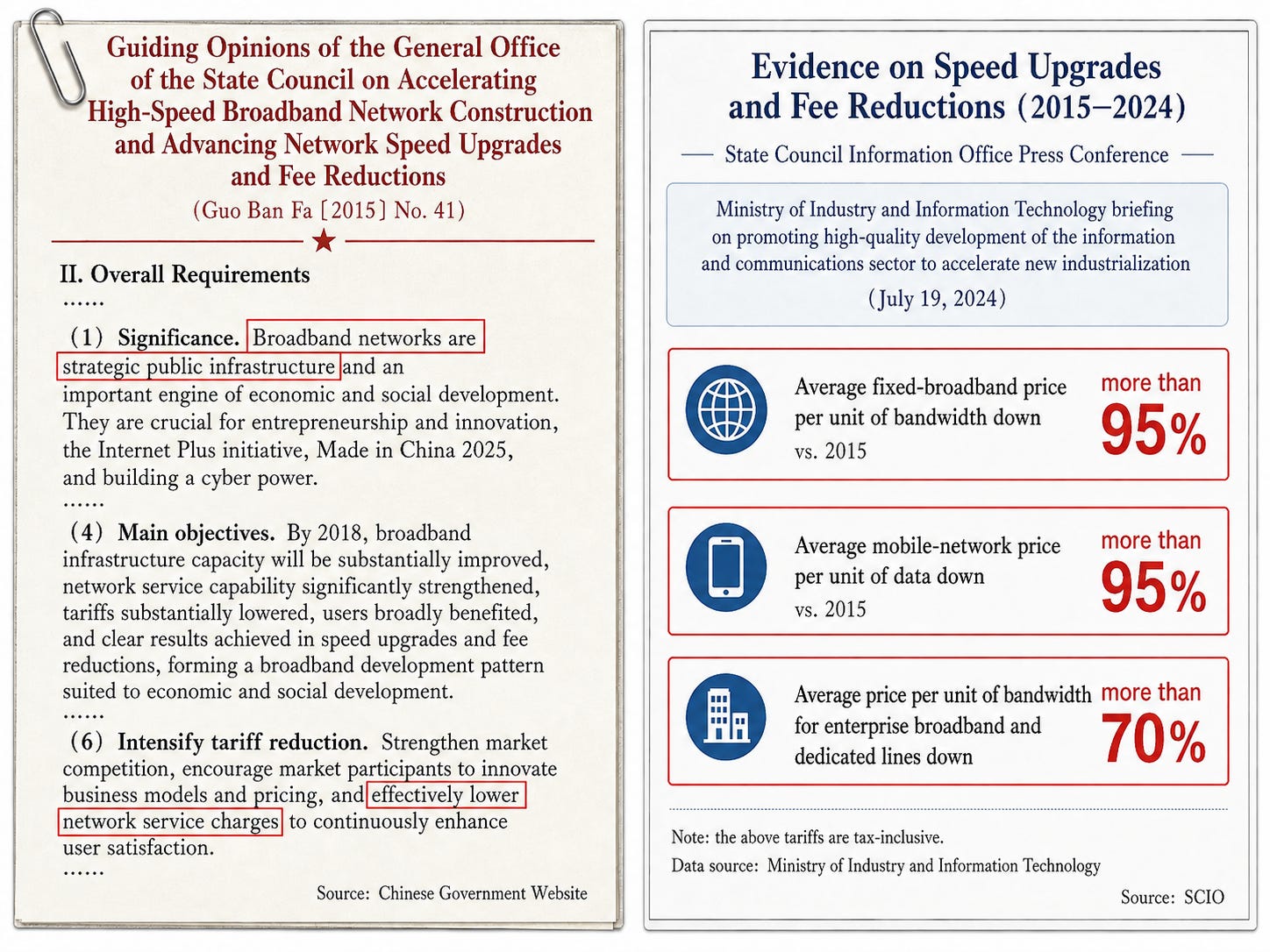
Lower prices did not destroy the value of communications. The opposite happened. People moved from counting every megabyte to streaming video, broadcasting live, navigating, paying, and working remotely. The network changed from an occasional tool into a continuously available environment.
The deepest achievement of “faster speeds and lower fees” was a transformation of the state’s role.
At the beginning, the state used installation fees to raise construction capital. When the network matured, it removed entry charges and rebalanced tariffs. When competition emerged, it added interconnection, universal service, state-enterprise responsibility, and consumer rights, pushing lower equipment costs, scale economies, and technical progress into the bill paid by each user.
The state can create high prices, and it can end them. The difference lies in whether it sees itself primarily as a capital raiser, resource operator, and rent collector—or as the guarantor of price transmission and universal service.
Not a Chinese Exception
If Chinese telecommunications reform were the only example, it could be dismissed as a special result of a special ownership system. International markets offer cleaner comparisons.
International roaming in the European Union was long a classic market that could lower prices but had little incentive to do so. Consumers rarely selected a domestic operator based on occasional foreign roaming, while operators charged one another wholesale roaming fees and easily passed those charges onward at retail.
Operators therefore had weak incentives to cut prices voluntarily. In 2010, the Body of European Regulators for Electronic Communications stated explicitly that declines in voice and SMS roaming prices were driven mainly by regulation, not competitive pressure; without regulation, prices for ordinary consumers with little bargaining power might rise again.10
The turning point was intervention at the EU level. The Union reduced wholesale roaming caps and, from 2017, abolished additional retail roaming charges for consumers. The result was not unchanged demand and a simple transfer of profit from carriers to users. The European Commission found that summer 2019 data roaming volume reached seventeen times its pre-reform level. In its 2025 review, it continued to conclude that lower wholesale caps enabled operators to provide more roaming data without a general rise in domestic mobile tariffs.11
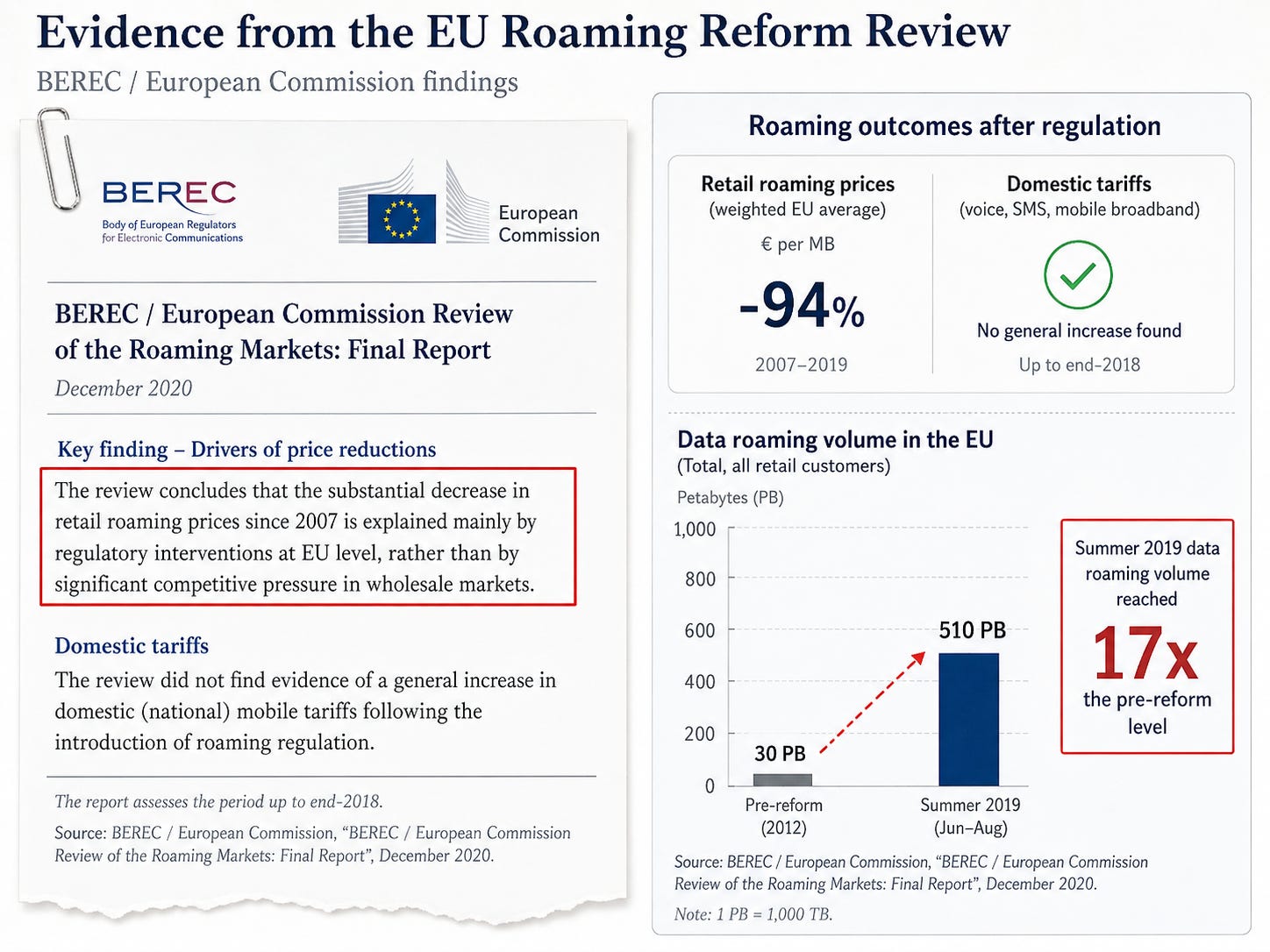
The resemblance to China’s campaign is striking.
A state or supranational institution reduces the wholesale price at a bottleneck, changes retail billing rules, and demand is released. A price cut does not merely redistribute profit from existing consumption; it creates use that high prices had previously prevented.
Public ownership can also discipline prices. The Berkman Klein Center at Harvard compared 27 U.S. markets in which a community-owned fiber network competed with one or more private broadband providers. In 23 of them, the community network had the lower four-year average cost, and its pricing was generally more stable and easier to understand. Public networks do not succeed everywhere, but the evidence shows that a public option can provide a real low-price benchmark rather than merely a symbolic form of ownership.12
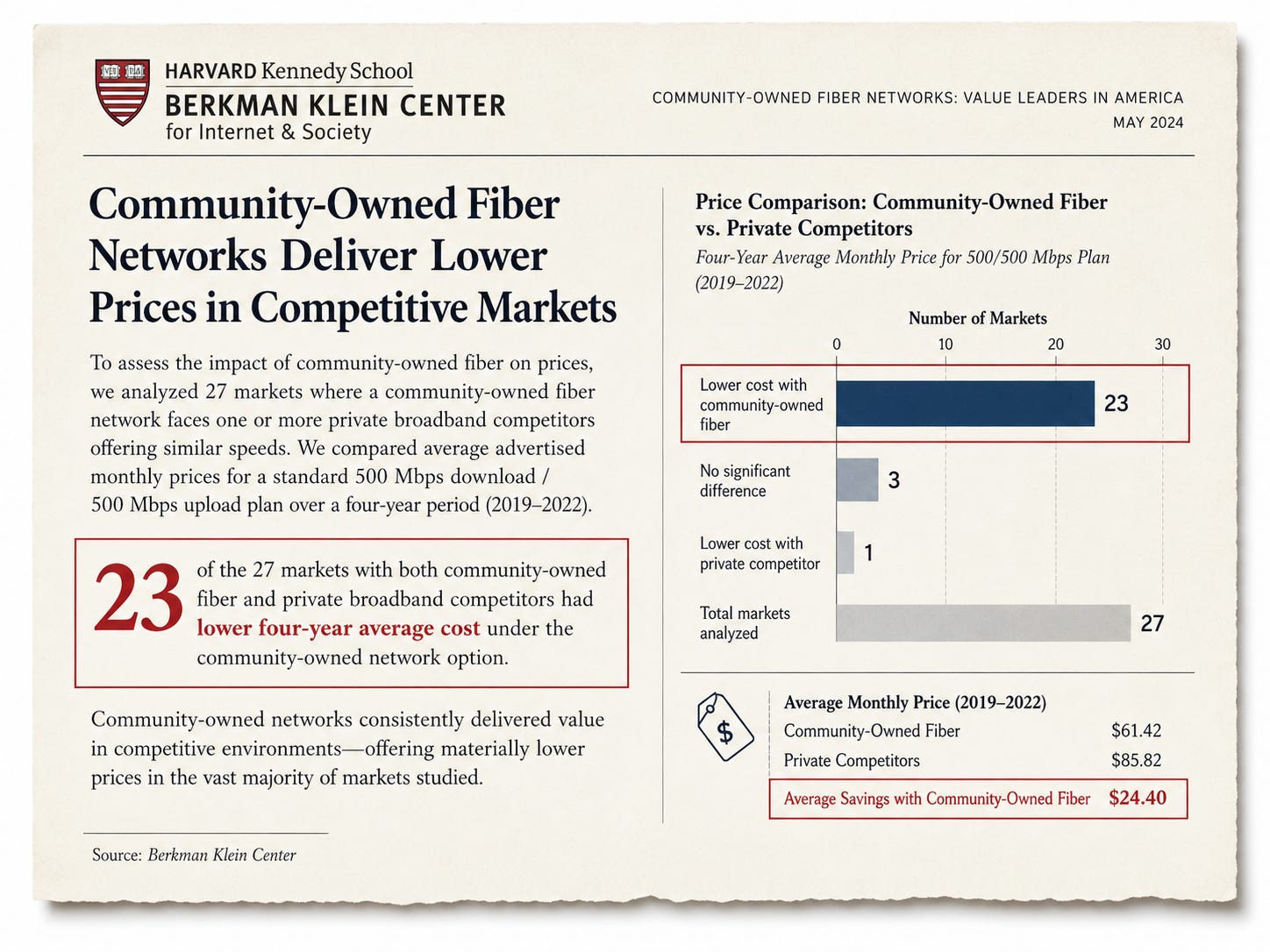
This does not mean every town should lay its own fiber and become an internet service provider. It means a public option is not a political artifact in a museum. When it is genuinely usable, it gives the market a price-and-service benchmark and reminds private firms that users have somewhere else to go.
The counterexample from U.S. electricity is even more revealing. Alexander MacKay and Ignacia Mercadal compared states that restructured electricity markets with states that retained cost-based regulation between 1994 and 2016. Deregulated generation did achieve lower marginal costs, but wholesale prices did not fall with them. From 2000 to 2016, the markup between wholesale prices and marginal cost increased by $11.15 per megawatt-hour, and the additional wholesale profit raised retail electricity prices.
This is almost a textbook model of the problem discussed here: technology and operating efficiency improve, upstream costs decline, and the final price can remain perfectly still.
When an intermediary has sufficient market power, a cost reduction can become profit rather than affordability.
It is therefore reasonable to say firmly that state intervention can reduce prices. Chinese telecommunications, EU roaming, and American community fiber demonstrate, respectively, administrative repricing, wholesale regulation, and public options. U.S. electricity shows the converse: without price transmission and constraints on market power, lower costs do not automatically benefit users.
Whether intervention lowers prices depends on whether the state is building a passage or operating a tollbooth.
Left entirely to private operators, the incentive to build passages often disappears. Everyone becomes very good at guarding the gate.
In the AI Era, the Cost-Reduction Chain Breaks Midway
Once the history is described carefully, the contemporary problem becomes easier to see.
Policymakers have plainly recognized part of it and are beginning to build a new system.
China has invested heavily in data centers, intelligent-computing centers, and an integrated national computing network. Policy documents call for “inclusive and easy-to-use” computing infrastructure, greater supplies of low-cost, high-quality, accessible compute, interconnected heterogeneous resources, unified services, usage-based billing, and lower costs for users. Beijing has also begun discussing token service quality, billing standards, value-based pricing, public compute, and token vouchers.13
But with so much historical experience before us, why are affordable token services still hard to find?
The answer is probably that a data center is not an intelligent service, and FLOPS are not a completed task.
Between a publicly supported computing center and an agent in a developer’s hands lie chips and runtimes, cloud platforms, model providers, hosting services, model routers, search and tool providers, application products, and payment channels. Every layer can add cost. Every layer can alter quality.
This “token onion” creates at least four price effects.
The first is multiple marginalization. Cloud providers, model companies, routers, agents, search tools, and payment channels all charge something. Each charge may look defensible in isolation; combined, they can consume the downstream application’s margin before it has earned a dollar from users.
The second, more hidden problem is vertical integration. A platform that owns cloud infrastructure, a model, and a consumer product can serve its own application at internal cost or subsidize a cheap subscription with revenue from elsewhere. An independent developer must buy the same capability at the public API price. A cheap consumer product and an impossibly expensive application-development environment can therefore coexist.
This resembles the wholesale-access problem in telecommunications. When the owner of the basic network also sells retail services, a formally open market means little if wholesale terms are punitive. In AI, the company controlling cloud and model capacity may sell tokens to application firms while building office, search, coding, and agent products of its own. Whether the public API is a fair wholesale price or a wall built for independent developers is mostly explained by the platform itself. The OECD has already identified self-preferencing, tying, denial of critical inputs, and cross-layer exclusion as important competition risks in AI infrastructure.14
The third effect is opaque routing and quality.
Routing itself is useful. RouteLLM experiments showed that sending simple requests to cheaper models and reserving stronger models for difficult requests can cut costs substantially while maintaining roughly comparable performance. Platforms such as OpenRouter allow users to select providers by price, throughput, or latency.15
Transparent routing saves users money. Opaque routing may hide a weaker model, lower-precision inference, a shorter context window, a smaller reasoning budget, or repeated fallback behind the word cheap.
This is the largest difference between tokens and water, electricity, or mobile traffic. Once a unit of electricity enters the grid, it does not illuminate fewer lamps because it came from a different power plant. One million tokens, however, may come from different models, versions, inference providers, quantization levels, and context policies. Their probability of completing the task can be entirely different.
Model companies quote a price per million tokens. Developers purchase a service bundle that may change at any moment. A “token price cut” may reflect genuine technical progress, routing efficiency, or caching. It may also reflect context reduction, service degradation, or a decision to hide formerly visible costs inside request allowances, credits, and five-hour windows.
The fourth effect is risk shifting. Failed agents still incur charges. Automatic retries still incur charges. A long trajectory that drifts off course and continues confidently still incurs charges.
A 2026 study of software-engineering agents using eight frontier models found that agentic tasks could consume roughly one thousand times as many tokens as ordinary code question answering; repeated runs of the same task differed by as much as thirtyfold; higher token consumption did not reliably produce better results; and models tended to underestimate their own future use.16
The platform is paid according to how much computation the machine performed. The user benefits only if the task was completed. Current billing therefore transfers much of the risk from model instability, agent design, and task uncertainty to the user.
That helps explain why the OECD can find that quality-adjusted text-model prices fell by almost 80 percent between early 2024 and April 2026 while users still feel that AI is expensive. A token becomes cheaper; an agent can consume orders of magnitude more tokens. The underlying model price falls; routing, tools, retries, and application layers continue adding cost.17
Market competition can lower one layer. Chinese models, open-source models, and model routing are already doing so, forcing frontier providers to respond.
But the market cannot spontaneously create a unified price order across compute, models, routers, applications, and data.18
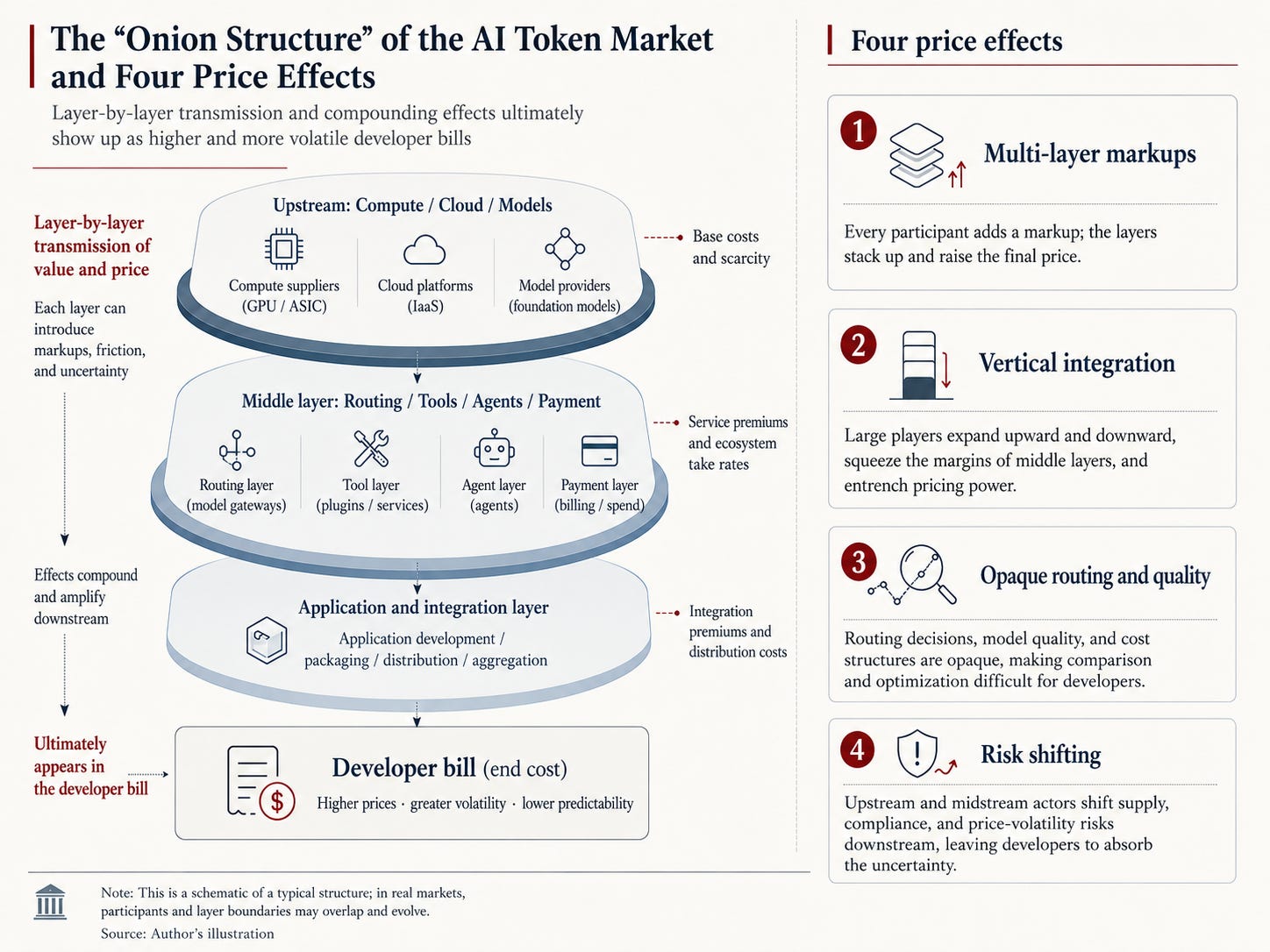
That is why the missing public-policy ecosystem is the biggest institutional factor.
Chip, electricity, and research costs explain why AI was expensive at an early technical stage. They do not fully explain where the savings go after quality-adjusted model prices fall rapidly while enterprise bills remain unpredictable.
Long contexts and retries explain why token consumption rises. They do not explain why the user must bear almost all failure risk.
Market concentration and vertical integration explain profit and lock-in. They are also exactly the problems that wholesale-access rules, nondiscrimination, portability, and competition enforcement are meant to address.
These different explanations converge on one problem: government has not yet built a system that reliably transmits technical cost reductions into lower prices across the entire market.
That is what “the biggest institutional factor” means. It does not claim that the absence of policy adds more dollars to every individual bill than chips, electricity, or model research. It means that, among structural factors that public institutions can change, the price-transmission mechanism governs who receives the gains from technical efficiency and who bears the risk of failure.
The present reality is that government is large in industrial policy and small in the public price order.
The Birth of a Second Installation Fee
A price chain that discusses only models and compute is incomplete. As Fei-Fei Li and many practitioners repeatedly emphasize, AI’s other foundational input is data.
One could go further: data is the foundation of AI.
China and other countries share one fact about data governance: a large share of the highest-quality and most authoritative data is produced, held, and used inside government.
I have worked on public-data compliance projects. Firms are intensely interested in government-held collections: bibliographic data, industrial data, service data, application data, interaction data, and data generated in real operating environments.
Many market-oriented jurisdictions rely heavily on disclosure duties, open-data rules, and reuse frameworks, and in some areas—including library and application data—private firms can obtain public resources relatively easily. China has instead placed great emphasis on data assetization and the “authorized operation” of public data: designated operators develop products and services from government-held data, often within a regulated charging framework.
Telecommunications networks and public data meet at one important point: a great deal of each is controlled by public authority or state-owned entities. They differ in another: communications capacity is congestible and consumable, while data can be reused. One developer’s use of a weather, transport, or company-registration dataset generally does not prevent another developer from using it simultaneously.
The case for opening public data is therefore, in some respects, even stronger than the case for telecommunications universal service.
Yet China’s current pricing mechanism for the authorized operation of public data allows charges for data products and services used in industry development. Maximum permitted revenue is calculated under the principle of “cost compensation plus reasonable profit.” The cost base may include platform construction and operations, transmission, aggregation, storage, governance, human resources, and expenses incurred in obtaining public data. Permitted profit is then calculated on the basis of those operating costs.19
The system is intended to stop operators from charging whatever they like. But its structure contains a dangerous positive-feedback loop: the more complicated the platform, the longer the process, and the more costs that can be recognized, the larger the base for permitted revenue and profit.
A self-reinforcing cycle can follow. Data that could have been released directly is moved into an authorized-operation platform. Operating the platform requires new systems, registration, governance work, and packaged products. Those new costs are then used to prove that charging is necessary.
This begins to look like a second installation fee for the intelligent age.
Public finance has already paid once for administrative work, urban operations, and data collection. A developer who wants to use the same data inside a model or application must then pay again for the platform, governance, authorization, and profit. Public money lowers compute costs at one end of the chain, while public-data assetization adds cost back at the other.
The problem is not building an inventory of public data. It is turning the inventory into a billing ledger. The problem is not governing sensitive data. It is forcing data that could be opened to become an asset before it can be used.
Chinese empirical research points toward another path. A 2025 study in the Journal of Finance and Economics treated the launch of local public-data platforms as a quasi-natural experiment. It found that public data openness significantly promoted corporate digital-technology innovation, mainly by increasing data supply, encouraging digital investment, and lowering perceived policy uncertainty. The effect was stronger among non-state-owned firms, and higher-quality openness produced stronger innovation effects.20
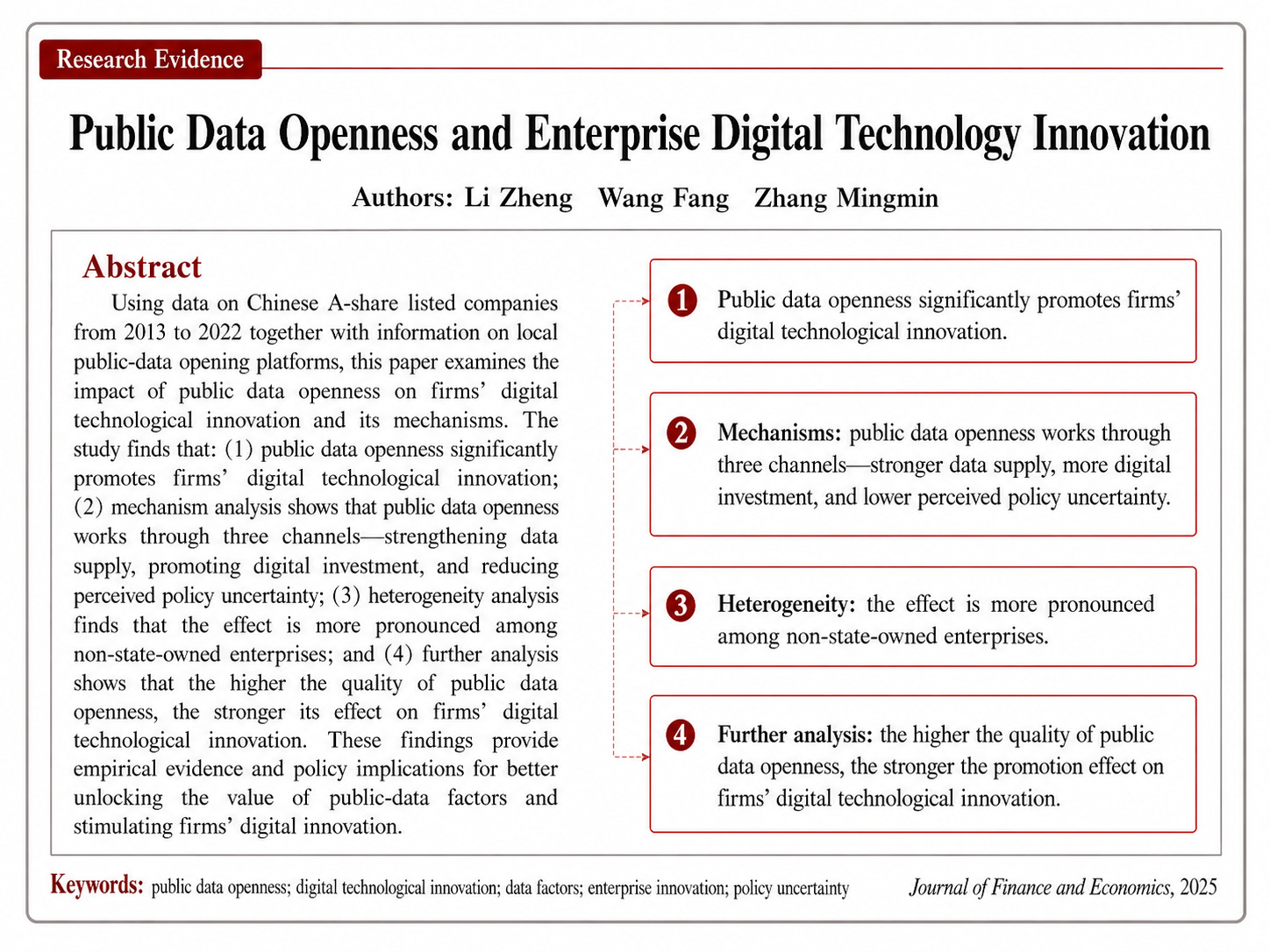
Another study of privately owned listed companies estimated that public data openness increased patent applications by an average of about 7.8 percent, with particularly strong effects among younger firms. Public data openness can improve the competitive environment, reduce operating risk, and give entry opportunities to firms whose business models are not yet proven.21
The deeper value of this research is that it does not treat public data’s worth as a number on an appraisal report. Once data becomes easier to obtain, firms are more willing to invest, more capable of developing new technologies, and better able to judge whether a business can be sustained.
International experience is even more intuitive. The United States shifted Landsat satellite imagery to a free and open model in 2008. The U.S. Geological Survey later assessed the possibility of charging again and concluded that net revenue might be smaller than the cost of building and operating the charging system, while fees would also damage the commercial remote-sensing and value-added services industries. After free access, downloads and applications expanded by orders of magnitude.22
Heidi Williams used the contrast between the public Human Genome Project and the privately controlled Celera data to estimate that Celera’s intellectual-property control over some genes reduced follow-on scientific research and product development by roughly 20 to 30 percent. Even temporary exclusion can leave persistent innovation losses.23
A small amount of direct rent from foundational data can destroy a much larger amount of downstream innovation.
Public foundational data should therefore not be assetized by default. Valuation may be useful in mergers, specific transactions, damages claims, and internal management. Those special purposes should not turn valuation into a general precondition for public-data access, research use, or AI training.
Personal information, trade secrets, and public-security data require purpose limitations, secure environments, output review, and operational auditing. That is risk governance. Risk governance does not require turning data into an asset first, nor does it require a property gate designed for recurring rent.
The telecommunications history suggests a better division: foundational public facts should be free, machine-readable, available in bulk, and licensed non-exclusively. Sensitive data can be used in controlled trusted environments. Customized cleaning, real-time interfaces, authenticity certification, dedicated compute, and service-level guarantees may be charged at the actual incremental cost of providing them.
Let companies make money from value-added services rather than extracting rent at the source of public facts.
A Public Affair
The preceding history allows us to imagine a model for public intervention in token services.
Reality still matters. AI was not created by the state alone, and lowering AI prices cannot begin with a crude decree that “one million tokens may not cost more than X.” Tokens do not have stable quality. A uniform cap or mandatory single access model could drive smaller model companies out of the market, strengthen giants capable of indefinite cross-subsidy, or convert a nominal price increase into throttling, queues, shorter contexts, and lower quality.
What government must rebuild is the transmission chain from foundational inputs to useful tasks.
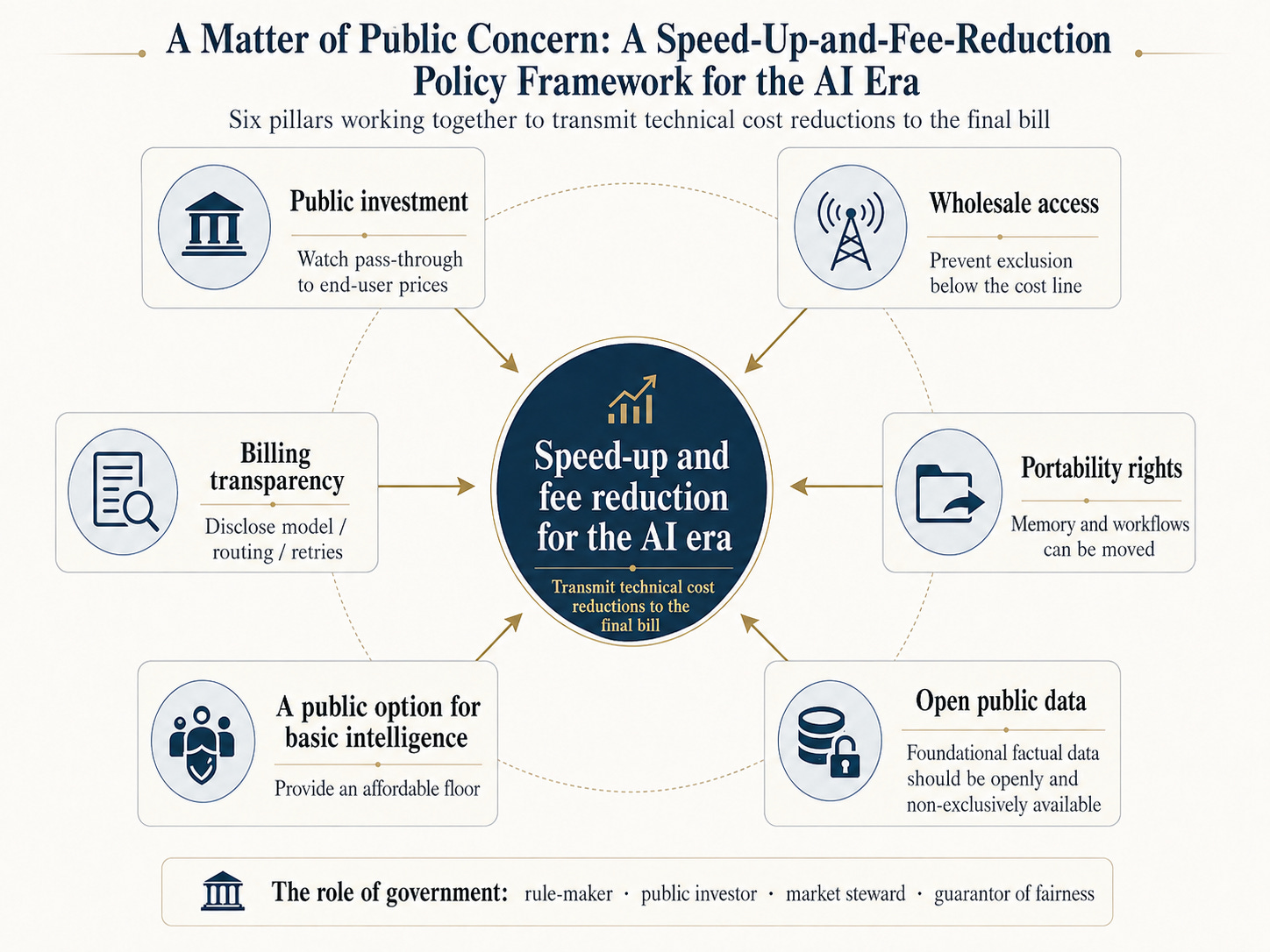
The first place to begin is public input.
A platform that receives public data-center capacity, preferential electricity, fiscal subsidies, compute vouchers, government procurement, or state capital should not be allowed to report only how many accelerators it bought or how many machine rooms it built. It should also disclose how much upstream compute costs fell, how much its prices to model providers fell, and how much token prices ultimately fell.
The objective of public support cannot stop at “producing more tokens.” A leaderboard of token consumption would be as intelligent as opening every faucet and holding a contest for who wastes the most water. If public investment merely gives an upstream platform cheaper compute without producing an observable reduction in developer prices, the subsidy may have become platform profit midway down the chain.
The agentic-AI boom has also shown why government procurement, industry evaluation, and consumer comparison cannot continue to focus only on price per million tokens. They need an effective intelligence price index.
The idea is familiar across the industry: select representative coding, research, translation, contract-review, customer-service, and agent-execution tasks; calculate the full-stack cost of producing an acceptable result; and publish success rate, failed-run share, human-review time, median cost, and 90th-percentile cost. The actual model, provider, context truncation, routing fallback, tool calls, and automatic retries should all appear on the bill.
AI is a peculiar commodity. When an electricity meter turns, the light usually comes on. When a gas meter moves, the stove usually heats. An agent can consume millions of tokens and leave behind nothing but slop.
A token is therefore not the productive result the user is buying. It is a technical metering and commercial-settlement unit for model processing—more like the kilowatt-hour on the meter than electricity’s useful output. The actual productive input is the combination of compute, model capability, data, and the service assembled from them.
That is why the market is already using fixed monthly fees, request allowances, credits, and rolling time windows to patch over the uncertainty of per-token billing. Those packages spare users from watching every call, but create another problem: one request, one credit, or one five-hour allowance on one platform cannot be compared with the same label elsewhere. Consumption changes with the model, context, mode, and product rules.
Only when public funds buy services according to “how much did it cost to get the job done?” will providers have an incentive to reduce failed and wasteful computation rather than merely sell more tokens and encourage users to generate more garbage.
The next issue is wholesale access.
Where a company controls a critical cloud, model, or data gateway while also operating downstream applications, competition enforcement should scrutinize refusal to deal, tying, self-preferencing, exclusionary agreements, and margin squeezing. Regulators do not need to declare every leading model a public utility. They do need to ask whether the platform’s internal terms for its own applications permanently place independent developers—the smallest units of innovation—below the cost line.
The telecommunications era required network interconnection. The AI era requires capability interconnection. Model APIs, tool protocols, and identity systems should be standardized where possible. Switching a model should not require rewriting an entire product.
The bill itself also needs regulation.
Platforms should disclose the model, version, and inference provider actually used. They should state whether a quantized model was used, whether context was truncated, whether routing fallback occurred, and how many tokens were consumed by caching, search, tool calls, and automatic retries. Routing should continue to develop, but cost savings cannot depend on the user not knowing what was purchased.
Users should be able to set hard budget limits that are not exceeded by default. System errors, empty responses, and futile retries initiated by the platform should not automatically be charged to the user.
Portability is the central data right in this context. As AI becomes embedded in daily life, people will connect it to personal, professional, and household information. The “super-ecosystem” dreamed of by platform companies may finally become real. Portability will therefore matter more, not less.
Conversation histories, long-term memories, knowledge bases, vector data, prompts, and agent workflows should be exportable and portable. Number portability in telecommunications allowed a user to switch carriers without abandoning an entire social network. If moving between AI platforms means retraining one’s digital beast of burden from the beginning, introductory discounts can easily become bait for later price increases, and the accumulated switching cost becomes the platform’s license to behave however it wishes.
Finally, not everyone and not every task requires the most expensive frontier intelligence. To reduce the waste created by this mismatch, the state should provide a genuinely useful basic public AI option.
It need not offer unlimited access or displace private products. Its purpose is to give ordinary individuals and firms an affordable, sustainable, comparable floor.
The option must work inside real workflows: compatibility with mainstream tools, support for continuous tasks, clear allowances and hard budget limits, and models capable of more than a demonstration. A public service cannot be judged by whether a “token package” was announced. If no one knows where to buy it, buyers cannot connect it to their tools, and developers find it more expensive than the market alternative, it is only another press-release graphic.
Public compute, wholesale access, transparent billing, user portability, and open public data together would constitute a real “faster speeds, lower fees” agenda for the AI era.
Remove any one of them and the cost reduction may simply be added back at the next gate.
Do Not Extract Rent from Basic Capabilities
As early as 1999, the Chinese telecommunications economist Yang Peifang divided the internet industry into layers. The lowest layer—the telecommunications channel—could support only a small number of operators. Competition increased as one moved upward into access, content, and e-commerce, and the appropriate intensity of regulation changed at each layer.24

More than two decades later, the layered approach has not become obsolete. It is especially illuminating for AI.
This essay would not have been written without Professor Yang’s ideas.
Yang spent decades discussing the information economy and what he called the “Third Civilization.” He treated socialized infrastructure and network services—high-speed rail and communications among them—as important development achievements of China’s reform era. He argued that the information economy should be organized through the foundational role of markets, the safeguarding role of government, and the coordinating role of society.25
The value of that framework is that it refuses two easy answers.
One answer is to leave everything to the market and assume that model competition, open source, and progress in compute will eventually solve the price problem automatically. The other is to bring every model into public ownership and have government decide the price of every product and service.
A more sensible division is for the state to build long-term infrastructure, constrain bottlenecks, and guarantee universal access; for markets to compete over models, applications, and value-added services; and for universities, open-source communities, and civil society to co-produce knowledge, models, and public tools.
In Yang’s thinking and that of many other Chinese scholars, one principle recurs: bu yu min zheng li—the state should not compete with the public for gains at the level of basic infrastructure.
That does not merely mean asking a state-owned or private company to make less money out of moral restraint. It is a longer calculation of returns.
The state need not collect cash from every model call, every item of public data, and every foundational interface. Cheap intelligence can create more firms, employment, productivity, research, and cultural production; it can expand consumption and the long-run tax base. Those benefits are much larger than the direct revenue on a token bill, even if they do not immediately appear in one department’s accounts.
Only when data charges fell far enough that people stopped counting every megabyte did the internet become a continuously available environment rather than an occasional tool. Many of the most important internet products were not planned in advance by a ministry. Ordinary people discovered them—by scrolling, playing, wasting time, experimenting, and building things on cheap connectivity.
AI prosperity requires the same right to experiment.
Translation and image-localization note: The argument and original Chinese draft are the author’s. The English translation and the English localization of illustrative graphics were prepared with AI assistance and manually reviewed. Text-heavy evidence graphics were re-typeset rather than generatively redrawn so that figures and source attributions would remain stable.
Except where otherwise noted, the text and author-created diagrams are released under the CC BY-SA 4.0 International License.
Redistribution, adaptation, and commercial reuse require appropriate attribution, an indication of modifications, and the same or a compatible license for derivative work.
Third-party images, trademarks, quotations, and separately identified materials are outside this license.
Notes
[1] OECD — Artificial Intelligence and Competitive Dynamics in Downstream Markets
[2] World Bank — Infrastructure regulation and development
[3] U.S. Federal Trade Commission — AI partnerships and investments study
[4] Ministry of Commerce policy database — Chinese antitrust guidance for public utilities
[5] OECD — Review of the Development and Reform of the Telecommunications Sector in China
[6] Chongqing Development and Reform Commission — abolition of telecommunications construction levies
[7] National Energy Administration mirror of State Council Office Document No. 41 (2015)
[8] Ministry of Industry and Information Technology — telecommunications universal-service pilots
[9] State Council Information Office — achievements in faster speeds and lower fees
[10] BEREC — roaming market review
[11] European Commission — Review of the Roaming Market
[12] Berkman Klein Center — Community-Owned Fiber Networks: Value Leaders in America
[13] National Development and Reform Commission — integrated national computing network
[14] OECD — Competition in Artificial Intelligence Infrastructure
[15] ICLR 2025 — RouteLLM
[16] Stanford Digital Economy Lab — How Do AI Agents Spend Your Money?
[17] OECD — Artificial Intelligence Markets
[18] Reuters — Rising AI bills reshape model choice
[19] National Development and Reform Commission — pricing mechanism for authorized public-data operations
[20] Journal of Finance and Economics — Public Data Openness and Corporate Digital-Technology Innovation
[22] U.S. Geological Survey — Why charging for Landsat data is not worth the economic and social cost
[23] NBER — Intellectual Property Rights and Innovation: Evidence from the Human Genome
[24] Peking University BiMBA — Yang Peifang on layered internet governance
[25] Beijing Normal University — Yang Peifang and the “Third Civilization”